Gepants for the Treatment of Migraine in Children and Adolescents: Acute and Preventive Roles, Current Evidence, and Ongoing Trials
Article information

Abstract
Migraine affects approximately 10% of children and adolescents and is often disabling, but evidence-based options for acute treatment and prevention remain limited. A high placebo response has also complicated pivotal pediatric trials. Therapies targeting the calcitonin gene-related peptide (CGRP) pathway have reshaped adult migraine care, and the approval of one CGRP monoclonal antibody for pediatric prevention has validated this target in pediatric patients. Gepants, small-molecule oral or intranasal CGRP receptor antagonists, are of particular interest because, unlike injectable antibodies, they offer acute or preventive treatment without vasoconstrictive activity. This review summarizes the pharmacology and adult evidence for the four approved gepants, their emerging pediatric use, and ongoing clinical trials. Depending on the agent, gepants have established efficacy for acute treatment or prevention in adults, with favorable long-term safety and no new hepatic or cardiovascular safety signals. Pediatric evidence is limited to small retrospective studies of off-label use in patients whose migraine is refractory to standard therapy. These reports suggest acceptable tolerability and possible benefit in some patients, but controlled trials are needed to determine efficacy. Phase 3 randomized trials are evaluating ubrogepant for acute treatment and atogepant and rimegepant for the prevention of episodic and chronic migraine in pediatric patients aged 6–17 years for acute treatment and episodic migraine prevention, and 12–17 years for chronic migraine prevention, with estimated completion expected between 2027 and 2032. Until controlled data become available, gepant use should be individualized and restricted to patients who have not responded to standard therapies. Pediatric dosing, long-term safety, and the lower age limit of benefit remain key questions.
INTRODUCTION
Migraine is among the most common neurological disorders of childhood and adolescence, affecting approximately 10% of this age group and ranking as the most frequent headache diagnosis encountered in pediatric neurology practice.1 Its prevalence increases from childhood through adolescence, and pooled epidemiological data confirm a substantial global burden across this age range.2,3 Pediatric migraine is frequently disabling, disrupting school attendance, academic performance, sleep, and overall quality of life, and a proportion of patients progress to chronic migraine—together generating a clear need for effective acute and preventive therapies.1,2
Despite this need, the evidence base for pediatric migraine pharmacotherapy remains limited. The Childhood and Adolescent Migraine Prevention (CHAMP) trial, the largest randomized placebo-controlled preventive trial in pediatric migraine, found no significant benefit of amitriptyline or topiramate over placebo, while the active drugs were associated with more adverse events. Several explanations have been proposed, including a high placebo response, although it remains uncertain whether this reflects a general feature of pediatric migraine trials or factors specific to the study.4 Reflecting such findings, current guidelines provide only limited, qualified recommendations for preventive and acute treatment, and many available agents are further constrained by tolerability concerns, leaving an important therapeutic gap.5-7
Against this background, therapies targeting the calcitonin gene-related peptide (CGRP) pathway have transformed adult migraine care and are increasingly being explored in the pediatric population.1,8 Among these, gepants—small-molecule oral or intranasal CGRP receptor antagonists with a favorable tolerability profile—are of particular interest.9
This narrative review summarizes the pharmacology of gepants, the current evidence for their acute and preventive use in children and adolescents, and the ongoing clinical trials that may shape their future role in this population, with particular emphasis on prevention. For this narrative review, PubMed/MEDLINE was searched and ClinicalTrials.gov was accessed for ongoing trials, both through August 15, 2026, using terms related to gepants, CGRP, migraine, and children or adolescents.
MIGRAINE IN CHILDREN AND ADOLESCENTS: AN OVERVIEW
Migraine is one of the most common and disabling neurological conditions of the developmental years. Systematic review data indicate a migraine prevalence of up to 7.7% in children and adolescents, with clinic- and population-based estimates around 9%–10% and a general rise in prevalence with age.1,2,10 Reported figures vary because of differences in case definition and methodology, but the consistent message is that migraine is a substantial problem throughout the school-age and adolescent years.2 Beyond attack-related pain, pediatric migraine impairs school attendance, academic achievement, and social and extracurricular participation, and its effects extend to caregivers; comorbidities such as sleep disturbance and allergic disease are common.2 In the Global Burden of Disease (GBD) study, migraine ranks among the leading causes of disability from adolescence onward, and because it frequently persists into adulthood, effective control during childhood and adolescence is an important clinical priority.1,2
Diagnosis follows the International Classification of Headache Disorders, third edition, although its application in children and adolescents requires attention to age-specific features.11 In patients under 18 years, attacks may be shorter—lasting 2–72 hours rather than the adult minimum of 4 hours—and headache is more often bilateral and typically frontotemporal, whereas isolated occipital headache is rare and calls for diagnostic caution.11 Aura may also present atypically in children, in whom discrete or clearly lateralized visual aura is less common than in adults.11 These age-specific features of attack duration, location, and aura, together with the difficulty younger children may have in describing symptoms, make careful diagnosis and exclusion of secondary causes essential before treatment is initiated.1
Management comprises two distinct treatment modalities: acute and preventive treatment. The goals of acute therapy are rapid and sustained relief that restores normal function, and early treatment of attacks is advised; for children and adolescents, the 2019 American Academy of Neurology (AAN)/American Headache Society guideline supports ibuprofen and specific triptans with pediatric approval.5 Even so, few agents carry pediatric regulatory approval, non-oral formulations are limited, and many children continue to experience inadequate relief compared with what is achievable in adults.10 Separately, even when acute treatment is available, some children have an insufficient response, which supports the need for effective preventive therapy.10
Preventive pharmacotherapy is even more constrained. Prevention is generally considered for children with frequent, prolonged, or disabling attacks, yet the corresponding 2019 AAN guideline could make only limited recommendations, reflecting a scarcity of high-quality pediatric evidence.6 These limited recommendations reflect the overall scarcity of high-quality pediatric trials and the frequently small or negative studies across multiple agents, rather than the result of any single trial.4 Moreover, the trials underlying these guidelines largely enrolled selected patients without chronic daily headache, limiting their generalizability to the more refractory cases encountered in practice.10 In this review, the terms refractory and resistant are used descriptively for patients who have not responded to or tolerated an adequate trial of standard therapies, without implying a specific numerical threshold.
The gap between guideline evidence and clinical reality is greatest in children with frequent or chronic migraine who fail multiple standard preventives. In a Korean pediatric cohort with chronic migraine, patients had typically failed more than two preventive therapies and carried a high disability burden before newer, mechanism-specific treatments combined with structured lifestyle interventions were introduced, after which migraine frequency declined over follow-up.12 These patients have limited treatment options, and the interpretation of pediatric trials is made difficult by high placebo responses. Together these factors have driven interest in therapies that directly target migraine pathophysiology. Both monoclonal antibodies and small-molecule receptor antagonists act on the CGRP pathway, and their success in adults has prompted systematic evaluation in children and adolescents.10,12
THE CALCITONIN GENE-RELATED PEPTIDE PATHWAY AND ITS TARGETED THERAPIES
CGRP is a 37-amino-acid neuropeptide produced by alternative processing of the calcitonin gene.13 It signals through an unusual receptor complex in which the calcitonin receptor-like receptor (CLR) must associate with receptor activity-modifying protein 1 (RAMP1) for full functionality, and it is among the most potent vasodilators known.13 Released predominantly from sensory nerves, CGRP is closely implicated in nociceptive signaling.13 In migraine, trigeminovascular activation triggers CGRP release from trigeminal neurons with consequent cranial vasodilatation; CGRP levels correlate with migraine pain, and its infusion can provoke attacks in susceptible individuals.14 These observations identified CGRP as a central mediator of migraine and justified therapeutic interruption of its signaling.
Whether this biology holds in children and adolescents has been addressed directly. Major components of the CGRP system are already developed and functional in the fetal and neonatal periods in animal models, and human studies have documented elevated CGRP levels in children and adolescents with migraine.15 The pathway is therefore functional during development, indicating that the target is present in children and adolescents. This also raises the possibility that sustained blockade could affect developmental processes, underscoring the need for long-term safety data; age-specific data on CGRP metabolism remain limited.15 Two drug classes target this pathway. Monoclonal antibodies targeting the CGRP ligand or its receptor (erenumab, fremanezumab, galcanezumab, and eptinezumab) are large biologics given parenterally at monthly or quarterly intervals and indicated for prevention only. Gepants are small-molecule CGRP receptor antagonists administered orally or intranasally that, depending on the agent, serve acute treatment, prevention, or both, without the vasoconstrictive constraints of triptans.14 Both classes are established in adults, and their favorable efficacy and safety profiles in adults prompted evaluation in pediatric patients, in whom use may be appropriate in selected clinical situations.16
Before controlled pediatric data existed, monoclonal antibodies targeting the CGRP pathway were used off-label in adolescents with severe, refractory headache. In a retrospective multisite cohort of 112 adolescents treated with an anti-CGRP or anti-CGRP-receptor monoclonal antibody (most with chronic migraine, a mean baseline of 26.9 headache days per month, and continuous headache in two-thirds), headache frequency fell significantly at first follow-up, whereas a clinically meaningful reduction in headache frequency was reported in only about 30% of patients. The most common adverse events were injection-site reactions and constipation, and few patients discontinued treatment.17 A single-center case series of eight children with intractable chronic daily headache who had failed a median of 6.5 prior medications, treated with anti-CGRP monoclonal antibodies (erenumab, fremanezumab, or galcanezumab), reported substantial improvement in disability scores without significant adverse events.18 These reports indicated acceptable tolerability but heterogeneous effectiveness in patients with the most refractory headache.
Randomized evidence subsequently confirmed efficacy in patients with episodic migraine. Among 234 children and adolescents aged 6 to 17 years with episodic migraine, monthly subcutaneous fremanezumab reduced monthly migraine days by 2.5 versus 1.4 with placebo (difference, 1.1; p=0.02), and 47.2% vs. 27.0% achieved a 50% or greater reduction in migraine days (p=0.002); injection-site erythema was the most common adverse event.19 In August 2025, fremanezumab became the first migraine preventive with a United States Food and Drug Administration label extending to children as young as 6 years, although the indication is restricted to episodic migraine in patients weighing ≥45 kg.20 In Korea, the Ministry of Food and Drug Safety approved fremanezumab in May 2026 for the prevention of episodic migraine in patients aged 6 to 17 years weighing at least 45 kg, making it the first and only anti-CGRP monoclonal antibody indicated for pediatric migraine prevention in this country. Months after the United States approval, however, the corresponding chronic migraine trial failed to demonstrate superiority over placebo, with improvement observed in both groups, echoing the high placebo response that has long complicated pediatric migraine trials.20
Trials of the remaining antibodies are ongoing. Phase 3 programs with open-label extensions are under way for erenumab, galcanezumab, and eptinezumab in patients aged 6 to 17 years with episodic or chronic migraine, with results anticipated from 2026 onward.20 The pediatric experience with monoclonal antibodies supports two points relevant to the role of gepants. First, the randomized data with fremanezumab provide clinical proof of concept that CGRP-targeted prevention can be effective in children and adolescents with episodic migraine, whereas efficacy has not been established for chronic migraine or for gepants specifically. Pediatric migraine trials have also been characterized by a high placebo response, which complicates interpretation of the observed treatment effects. Second, the monoclonal antibodies address prevention alone and require injection, leaving an unmet need for an orally available agent capable of covering both acute and preventive treatment—a role for which gepants are being investigated.14,16
GEPANTS: PHARMACOLOGY AND EVIDENCE IN ADULTS
Gepants are small-molecule competitive antagonists at the canonical CGRP receptor, developed to provide nonparenteral CGRP-targeted therapy with far shorter half-lives than the monoclonal antibodies, whose plasma half-life of roughly 1 month confines them to prophylaxis.21 Antagonism of the amylin 1 (AMY1) receptor, a second receptor at which CGRP is potent, may also contribute to their effect; the degree of AMY1 antagonism differs among gepants, and the clinical significance of this activity remains under investigation.9,21 Unlike triptans, gepants lack direct vasoconstrictive activity, making them a mechanistically attractive option for some patients in whom triptans are contraindicated, although caution may still be warranted in certain vascular conditions.14
Intravenous olcegepant proved effective for acute migraine more than two decades ago, but development of the first-generation compounds was halted by hepatotoxicity and formulation problems, which redirected the field toward monoclonal antibodies.21 Telcagepant, though effective acutely, caused dose-dependent drug-induced liver injury, with alanine aminotransferase elevations of more than 10 times the upper limit of normal emerging mostly between 4 and 6 weeks of continuous dosing. The hepatotoxicity of telcagepant was attributed to reactive metabolites arising from its specific chemical structure. Quantitative systems toxicology analyses subsequently showed that next-generation gepants such as ubrogepant do not share this liver liability, indicating that the injury was compound-specific rather than a class effect of CGRP receptor blockade.9,21-23
Four gepants are now approved in major markets, and their pharmacokinetics inform their clinical roles (Table 1). Ubrogepant, rimegepant, and zavegepant achieve peak plasma concentrations and high receptor occupancy within 1 to 2 hours, matching the window for aborting an attack. Ubrogepant (5–7 hours) and zavegepant (6–7 hours) have somewhat shorter elimination half-lives than atogepant and rimegepant (approximately 11 hours), which sustain therapeutic plasma levels across the dosing interval and were developed for prevention; because the half-lives of all four agents fall within a relatively narrow range, however, their current indications should be understood in light of their clinical development programs as well as their pharmacokinetics. Rimegepant carries both indications, whereas ubrogepant and zavegepant are approved for acute treatment alone. Atogepant, initially approved for prevention only, gained an additional acute indication in the European Union in June 2026, although it remains a preventive-only agent in the United States.9 All gepants are taken orally except zavegepant, the first third-generation agent, which is delivered intranasally—a route whose pharmacokinetic advantage over oral dosing is unconfirmed, though it may act locally on the trigeminovascular system, since the nasal cavity is lined with trigeminal nerve endings.21 Consistent with this, comparative pharmacological work shows that all gepants inhibit CGRP-induced responses at therapeutic plasma concentrations, yet the relatively low predicted systemic potency of zavegepant points to the relevance of local delivery.24
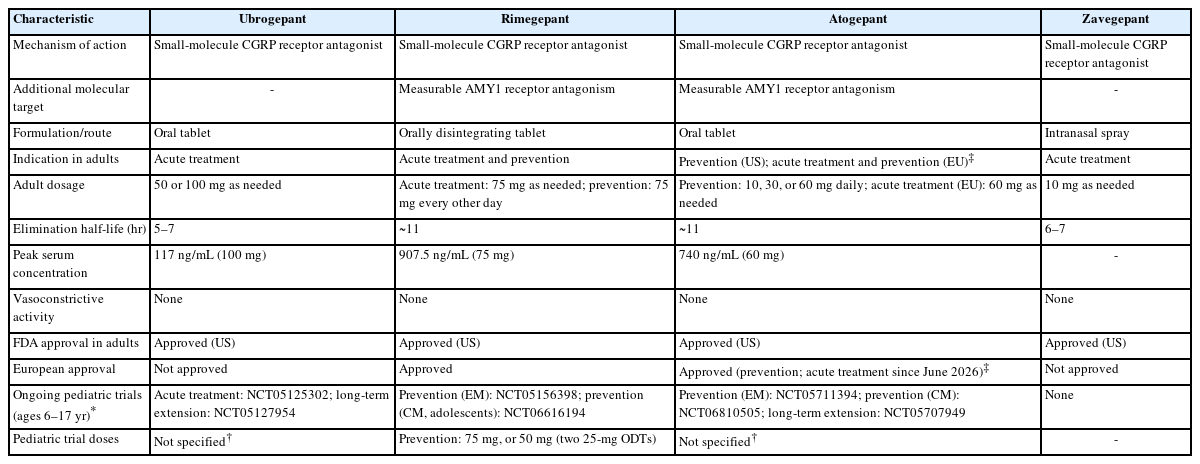
Pharmacological characteristics of the four approved gepants and ongoing pediatric trials
Pivotal trials in adults established efficacy across these roles. In 1,466 randomized adults, a single 75-mg dose of rimegepant, given as an orally disintegrating tablet, was superior to placebo at 2 hours for freedom from pain (21% vs. 11%; p<0.0001) and freedom from the most bothersome symptom (35% vs. 27%; p=0.0009), with tolerability comparable to placebo.25 Zavegepant nasal spray, evaluated in 1,673 randomized adults, met both coprimary endpoints at 10 mg and 20 mg, with 2-hour pain freedom of 22.5% and 23.1% vs. 15.5% for placebo.26 For ubrogepant, population pharmacokinetic and exposure–response analyses across phase 1–3 studies confirmed significant exposure–response relationships for 2-hour pain relief and pain freedom and for 24-hour sustained outcomes, and demonstrated benefit even when the drug was taken during the prodrome.27 Preventive efficacy was established in the phase 3 PROGRESS trial: among 778 adults with chronic migraine, monthly migraine days fell by 7.5 days with atogepant 30 mg twice daily and 6.9 days with 60 mg once daily, vs. 5.1 days with placebo (least-squares mean differences –2.4 and –1.8; p<0.0001 and p=0.0009), with constipation and nausea the most common adverse events.28
Long-term data are reassuring. Rimegepant sustains efficacy with minimal adverse events over 52 weeks; atogepant shows progressive benefit and favorable tolerability for up to 1 year; ubrogepant remains effective during extended intermittent use; and the most frequent adverse event with zavegepant is transient dysgeusia. Across the class, no consistent hepatic, cardiovascular, or serious systemic toxicity has emerged, and discontinuation for adverse events remains low.14 Most gepants are metabolized principally by cytochrome P450 3A4 (CYP3A4) and are substrates of efflux transporters, so co-administration with strong CYP3A4 inhibitors or inducers requires dose adjustment or avoidance under current labeling rather than attention alone; for atogepant, the recommended dose is reduced to 10 mg daily with strong CYP3A4 inhibitors, and concomitant use with strong or moderate CYP3A4 inducers is not recommended in chronic migraine. Co-administration with topiramate, a weak CYP3A4 inducer, decreases atogepant exposure and carries a corresponding dosing recommendation, whereas clinical pharmacology studies have shown no clinically significant interactions with oral contraceptives or triptans; dedicated interaction studies with anti-CGRP monoclonal antibodies have not been performed. Preclinical and preliminary clinical evidence suggests a low likelihood of gepants inducing medication-overuse headache.9
GEPANTS FOR ACUTE TREATMENT IN CHILDREN AND ADOLESCENTS
No gepant is currently licensed for acute migraine treatment in patients younger than 18 years, and all pediatric use is therefore off-label.29 The rationale for extrapolating from adults is nonetheless coherent. CGRP levels rise during migraine attacks in children and adolescents as they do in adults, and the receptor system is functional from early development, so the molecular target of acute gepant therapy is present in this age group.15 Two clinical considerations reinforce the appeal. First, the absence of vasoconstrictive activity makes gepants theoretically attractive where triptans are contraindicated or poorly tolerated—a point of practical relevance in hemiplegic migraine and migraine with brainstem aura.9 Second, guideline-endorsed acute options remain few in this population and many children obtain inadequate relief, so an additional mechanism-specific agent could address an important clinical gap.5,10
Direct pediatric evidence remains confined to a single retrospective series. Among 12 adolescents (mean age 15.3 years; 75% female) who received at least one dose of off-label rimegepant at a tertiary pediatric headache center, migraine subtypes included episodic and chronic migraine as well as hemiplegic migraine (25%), and patients had tried a mean of 3.9 acute medications beforehand, with a mean baseline of 11.5 headache days per month.29 During follow-up, 10 of 12 patients (83%) reported resolution or improvement of attacks. No patient reported side effects, and there were no statistically significant changes in height, weight, blood pressure, or laboratory values—including liver function tests—after rimegepant use.29 The authors emphasize that the sample is small, uncontrolled, and drawn from a refractory referral population, so the findings should be read as a preliminary safety and tolerability signal rather than as evidence of efficacy (Table 2).16,29
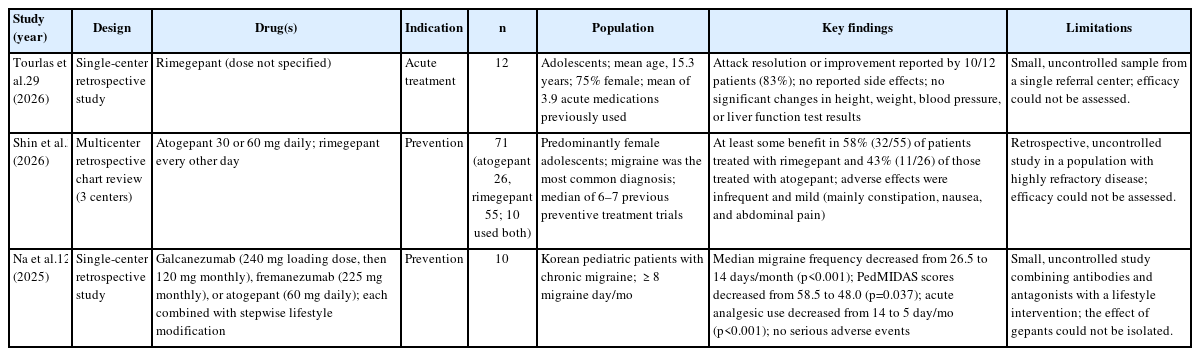
Real-world studies of gepants for migraine in children and adolescents
Definitive evidence awaits randomized trials, and these are under way for ubrogepant. A phase 3, randomized, double-blind, placebo-controlled single-attack study is evaluating the safety and efficacy of ubrogepant for the acute treatment of migraine in participants aged 6–17 years, with an estimated enrollment of 1,059 and completion anticipated in May 2027 (NCT05125302).30 A companion phase 3 open-label extension is assessing long-term safety and tolerability in the same age range, with an estimated enrollment of 1,200 and completion anticipated in January 2028 (NCT05127954). These studies are designed to generate placebo-controlled efficacy data and extended safety exposure in this age group (Table 3).31
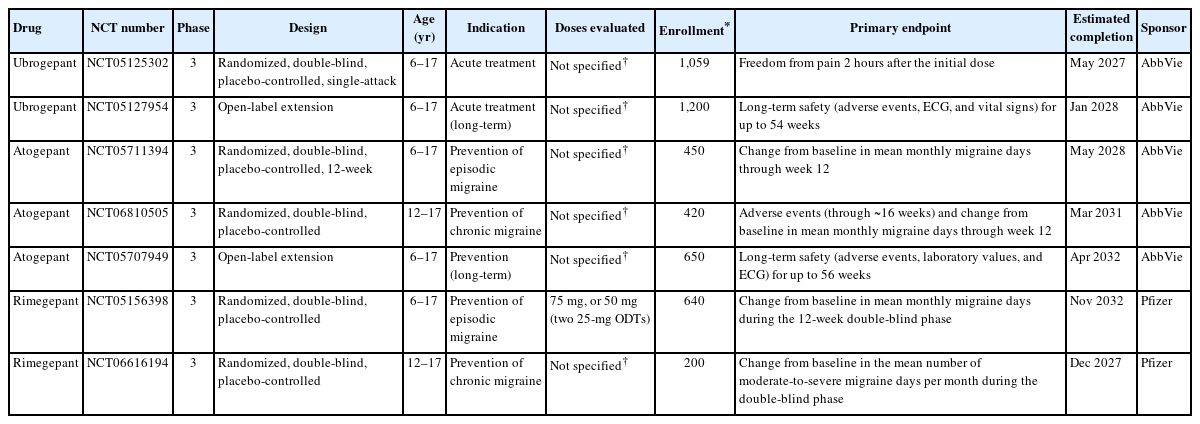
Ongoing trials of gepants for migraine in children and adolescents
At present, off-label acute gepant therapy in adolescents is supported by mechanistic plausibility and by robust efficacy data in adults, whereas the pediatric safety signal, although reassuring, remains preliminary. Off-label use may be considered in selected patients with failure of, or contraindications to, established acute therapies, with the understanding that the supporting pediatric evidence remains limited.10,29
GEPANTS FOR PREVENTIVE TREATMENT IN CHILDREN AND ADOLESCENTS
The need for better preventive options in pediatric migraine is the central problem this class may help address. Standard oral preventives are limited by inconsistent efficacy and tolerability, and children with frequent or chronic migraine who fail these agents have few remaining choices.10 Antibodies against the CGRP pathway have begun to fill this gap but require injection and, at present, are indicated only from age 6 for episodic migraine.19 An orally administered preventive acting on the same pathway would therefore be valuable, and the two gepants with preventive indications in adults, atogepant and rimegepant, are the leading candidates.9
As described in Section “GEPANTS: PHARMACOLOGY AND EVIDENCE IN ADULTS,” the preventive efficacy of atogepant in adults with chronic migraine was established in the phase 3 PROGRESS trial.28 A prespecified subgroup analysis further showed that atogepant was effective in patients with and without acute medication overuse: among 500 participants meeting overuse criteria at baseline, the least-squares mean difference from placebo in monthly migraine days was –2.7 with atogepant 30 mg twice daily and –1.9 with 60 mg once daily, and the proportion meeting overuse criteria fell by 52% to 62% over 12 weeks.32 Whether this benefit extends to children and adolescents, in whom comorbid medication overuse is also common, remains to be determined.10,32
Direct pediatric preventive evidence remains limited and derives mainly from one retrospective study. In a multisite retrospective chart review across three pediatric headache centers, 71 patients under 18 years were prescribed a gepant for prevention—26 atogepant, 55 rimegepant, including 10 who used both—most of them adolescent girls with migraine. These patients had highly refractory disease: the median number of previously failed preventive trials was six in the rimegepant group and seven in the atogepant group. Despite this, at least some benefit was seen in 58% (32/55) of rimegepant-treated and 43% (11/26) of atogepant-treated patients. Adverse effects were infrequent and mild, most commonly constipation, nausea, and abdominal pain, and few patients discontinued treatment.33 A Korean single-center study provides supportive real-world experience for CGRP-targeted therapy as a whole, rather than for gepants specifically. In 10 pediatric patients with chronic migraine who had failed more than two preventive therapies, treatment with CGRP monoclonal antibodies or receptor antagonists combined with structured sleep, dietary, and exercise interventions over 12 months reduced migraine frequency from a median of 26.5 to 14 days per month and lowered disability scores; the combined and multimodal design precludes isolation of a gepant-specific effect.12,33
Randomized trials are now under way. For atogepant, a phase 3, 12-week, double-blind, placebo-controlled study is evaluating preventive efficacy in episodic migraine in participants aged 6–17 years (estimated enrollment 450; completion May 2028) (NCT05711394), and a parallel study is evaluating chronic migraine in those aged 12–17 years (estimated enrollment 420; completion March 2031) (NCT06810505); a multicenter open-label extension is assessing long-term safety and tolerability in patients aged 6–17 years (estimated enrollment 650; completion April 2032) (NCT05707949).34-36 For rimegepant, a phase 3 study is evaluating preventive efficacy in patients aged 6 to under 18 years with episodic migraine (estimated enrollment 640; completion November 2032) (NCT05156398), and a further study is evaluating adolescents aged 12 to less than 18 years with chronic migraine (estimated enrollment 200; completion December 2027) (NCT06616194).37,38 These trials span both episodic and chronic migraine and pair efficacy assessment with dedicated long-term safety follow-up.
At present, therefore, preventive gepant use in children and adolescents is off-label and supported only by retrospective data. Established efficacy in adults and favorable, though uncontrolled, pediatric experience have made gepants the most actively investigated oral preventive option for pediatric migraine, although their place in practice cannot be defined until randomized results are available.9,33
SAFETY, TOLERABILITY, AND PRACTICAL CONSIDERATIONS
The safety signal to date is nonetheless reassuring. Across phase 3 trials in adults, a network meta-analysis of 19 randomized studies comprising 14,584 patients found that CGRP monoclonal antibodies and gepants were safe and well tolerated as preventives, with no significant difference in serious adverse events between active treatment and placebo.39 The most frequent adverse effects of gepants—constipation, nausea, and abdominal pain—are gastrointestinal and generally mild, and this profile is mirrored in pediatric experience, where such effects are infrequent and rarely limit treatment.33,39 Retrospective pediatric and young-adult cohorts treated off-label have likewise reported acceptable tolerability without new safety concerns.40
Liver safety deserves specific comment. The hepatotoxicity that halted first-generation gepants was compound-specific and has not recurred with the approved agents, and long-term data in adults show no hepatic signal.14 Consistent with this, the pediatric rimegepant series documented no significant change in liver function tests after use.29 Routine hepatic monitoring is therefore not mandated for the current gepants, though attention to interacting drugs and to agents metabolized by CYP3A4 remains prudent.21
Practical barriers, however, are substantial. Children with migraine refractory to standard therapy have often already experienced adverse effects or inadequate responses to multiple prior medications and frequently experience medication overuse, yet the newer agents are prescribed off-label and carry high insurance denial rates, limiting access where the need is greatest.40,41 Clinicians must therefore weigh the off-label status of these agents against the likelihood of obtaining coverage, and counsel families accordingly.
Pediatric migraine trials have frequently shown a high placebo response, which may reduce the observed difference between active drug and placebo across preventive studies in this population.8,20 Uncontrolled studies cannot exclude the contribution of the placebo response, so the true treatment efficacy cannot be determined from them. Until randomized data are available, gepant use in children and adolescents should be individualized, limited to patients who have not responded to standard therapies, and accompanied by discussion of the uncertain evidence with patients and families.16,41
FUTURE DIRECTIONS AND CONCLUSION
Phase 3 randomized trials are now enrolling children and adolescents across the full clinical spectrum—ubrogepant for acute treatment, and atogepant and rimegepant for the prevention of both episodic and chronic migraine—with primary completion dates ranging from 2027 through 2032.20,33 Long-term safety is being addressed in dedicated extension studies and open-label phases.
Several questions will remain even after these trials report. Appropriate pediatric dosing is not yet defined; exposure–response modeling that has helped calibrate dosing in adults will need to be extended to children, in whom body weight spans a wide range.24,27 Long-term safety during the developmental years—including any effect of sustained CGRP blockade on a system that is active from early life—will require data from the extension studies.15 The lower age limit at which benefit outweighs risk is unsettled, as is how gepants should be sequenced relative to monoclonal antibodies now that one antibody is approved from age 6.16,19 Finally, the high placebo response observed in pediatric migraine trials will continue to demand cautious interpretation of trial results.10,20
In conclusion, gepants are oral CGRP receptor antagonists with proven acute and preventive efficacy and a favorable safety profile in adults, and they address a genuine unmet need in children and adolescents, for whom effective and well-tolerated options are scarce.8,21 Present pediatric evidence is limited to retrospective, real-world experience that is consistent in direction and reassuring in tolerability, although efficacy remains to be determined in controlled trials.12,17,33,40 Until the ongoing randomized trials report, gepants should be regarded as an option for individual patients who have not responded to standard therapies rather than as routine therapy. The place of gepants in pediatric migraine care will depend on the results of these trials.
Notes
AVAILABILITY OF DATA AND MATERIAL
The data presented in this study are available upon reasonable request from the corresponding author.
AUTHOR CONTRIBUTIONS
Conceptualization: JHN; Data curation: JHN; Formal analysis: JHN; Investigation: JHN; Resources: JHN; Validation: JHN; Writing–original draft: JHN; Writing–review & editing: JHN.
CONFLICT OF INTEREST
No potential conflict of interest relevant to this article was reported.
FUNDING STATEMENT
The Korean Headache Society provided financial support for this project.
ACKNOWLEDGMENTS
The author thanks colleagues for helpful discussions while preparing this review. The author used Claude (Anthropic) to edit the language, assist in drafting background sections, and summarize the literature during manuscript preparation. The tool was not used to analyze statistics, interpret data, or generate original scientific content. The author has reviewed and verified all content and accepts full responsibility for the manuscript.