 KHS
KHS

Articles
- Page Path
- HOME > Headache Pain Res > Volume 27(2); 2026 > Article
-
Review Article
Trigeminal Neuralgia: Pathophysiology, Clinical Features, and Therapeutic Management -
Ekene Nnagha1
 , Chidubem Adi2, Daniel Akpan1
 -
Headache and Pain Research 2026;27(2):117-123.
DOI: https://doi.org/10.62087/hpr.2026.0005
Published online: June 4, 2026
1College of Medical Sciences, University of Calabar, Calabar, Nigeria
2School of Medicine, St. George’s University, St. George, Grenada
- Correspondence: Ekene Nnagha, M.B.B.Ch. College of Medical Sciences, University of Calabar, P.M.B 1115, Calabar, Cross River State, Nigeria E-mail: nnaghae@gmail.com
© 2026 The Korean Headache Society
This is an Open Access article distributed under the terms of the Creative Commons Attribution Non-Commercial License (https://creativecommons.org/licenses/by-nc/4.0) which permits unrestricted non-commercial use, distribution, and reproduction in any medium, provided the original work is properly cited.
- 1,615 Views
- 32 Download


Abstract
- Trigeminal neuralgia (TN) is a severe, disabling neuropathic facial pain disorder classified among cranial neuralgias within headache medicine. Despite well-established diagnostic criteria, TN remains frequently misdiagnosed, particularly in dental and primary care settings. This review provides a clinically focused overview of the epidemiology, pathophysiology, classification, diagnostic approach, and contemporary management of TN, with relevance to headache and pain research and clinical practice. Neurovascular compression with focal demyelination at the trigeminal nerve root entry zone is considered the predominant mechanism in classical TN. Diagnosis is primarily clinical and guided by International Classification of Headache Disorders, 3rd edition criteria, with magnetic resonance imaging essential for excluding secondary and idiopathic causes. Carbamazepine and oxcarbazepine remain first-line therapies, whereas microvascular decompression and minimally invasive neurosurgical procedures provide effective options for medically refractory disease. TN requires accurate diagnosis and individualized management. Advances in pharmacological and interventional treatments have improved outcomes and underscore the importance of multidisciplinary care within headache and pain medicine.
INTRODUCTION
EPIDEMIOLOGY
PATHOPHYSIOLOGY
CLINICAL FEATURES
CLASSIFICATION AND DIAGNOSTIC CRITERIA
COMPLICATIONS
DENTAL IMPLICATIONS
THERAPEUTIC MANAGEMENT
IMPLICATIONS FOR HEADACHE AND PAIN RESEARCH
FUTURE DIRECTIONS
CONCLUSION
AVAILABILITY OF DATA AND MATERIAL
Not applicable.
AUTHOR CONTRIBUTIONS
Conceptualization: EN; Resources: EN, CA, DA; Writing–original draft: EN, CA, DA; Writing–review & editing: EN, CA, DA.
CONFLICT OF INTEREST
No potential conflict of interest relevant to this article was reported. This manuscript was prepared with the assistance of ChatGPT-4 (OpenAI), used on January 26, 2026, for grammar and language refinement. All content generated with AI assistance was independently verified by the authors.
FUNDING STATEMENT
None.
ACKNOWLEDGMENTS
None.
- 1. Headache Classification Committee of the International Headache Society (IHS). The International Classification of Headache Disorders, 3rd edition. Cephalalgia 2018;38:1-211.ArticlePubMedPMCPDF
- 2. Araya EI, Claudino RF, Piovesan EJ, Chichorro JG. Trigeminal neuralgia: basic and clinical aspects. Curr Neuropharmacol 2020;18:109-119.ArticlePubMedPMC
- 3. Shankar Kikkeri N, Nagalli S. Trigeminal neuralgia. In: StatPearls [Internet]. StatPearls Publishing; updated 2024 Mar 3 [cited 2026 Jan 26]. Available from: https://www.ncbi.nlm.nih.gov/books/NBK554486/
- 4. Jeong YD, Jo Y, Son Y, et al. Global incidence and prevalence of trigeminal neuralgia, 1945-2024: a systematic review and meta-regression analysis. J Clin Neurol 2026;22:102-112.ArticlePubMedPMCPDF
- 5. Ashina S, Robertson CE, Srikiatkhachorn A, et al. Trigeminal neuralgia. Nat Rev Dis Primers 2024;10:39.ArticlePubMedPDF
- 6. Di Stefano G, Yuan JH, Cruccu G, Waxman SG, Dib-Hajj SD, Truini A. Familial trigeminal neuralgia: a systematic clinical study with a genomic screen of the neuronal electrogenisome. Cephalalgia 2020;40:767-777.ArticlePubMedPMCPDF
- 7. Gambeta E, Chichorro JG, Zamponi GW. Trigeminal neuralgia: an overview from pathophysiology to pharmacological treatments. Mol Pain 2020;16:1744806920901890.ArticlePubMedPMCPDF
- 8. Lambru G, Zakrzewska J, Matharu M. Trigeminal neuralgia: a practical guide. Pract Neurol 2021;21:392-402.ArticlePubMedPMC
- 9. Sacchetti M, Lambiase A. Diagnosis and management of neurotrophic keratitis. Clin Ophthalmol 2014;8:571-579.ArticlePubMedPMC
- 10. Golden E, Robertson CE, Moossy JJ, Sandroni P, Garza I. Trigeminal trophic syndrome: a rare cause of chronic facial pain and skin ulcers. Cephalalgia 2015;35:636.ArticlePubMedPDF
- 11. Martinelli R, Vannuccini S, Burattini B, et al. Psychological assessment in patients affected by trigeminal neuralgia. A systematic review. Neurosurg Rev 2025;48:414.ArticlePubMedPMCPDF
- 12. von Eckardstein KL, Keil M, Rohde V. Unnecessary dental procedures as a consequence of trigeminal neuralgia. Neurosurg Rev 2015;38:355-360.ArticlePubMedPDF
- 13. Tripathi M, Sadashiva N, Gupta A, et al. Please spare my teeth! Dental procedures and trigeminal neuralgia. Surg Neurol Int 2020;11:455.ArticlePubMedPMC
- 14. Di Stefano G, Truini A, Cruccu G. Current and innovative pharmacological options to treat typical and atypical trigeminal neuralgia. Drugs 2018;78:1433-1442.ArticlePubMedPMCPDF
- 15. Cho SJ. When should headache specialists hold a needle? The role of botulinum toxin injections and occipital nerve blocks. Headache Pain Res 2024;25:73-74.ArticlePDF
- 16. Zhao C, Shrestha N, Ren H, et al. The PATCH trial: 5% lidocaine-medicated plaster for trigeminal neuralgia—results of a multicentric, enriched enrollment, randomized withdrawal, double-blind, vehicle-controlled, parallel-group study. Headache 2024;64:1318-1328.ArticlePubMed
- 17. Schott Andersen AS, Maarbjerg S, Noory N, et al. Safety and efficacy of erenumab in patients with trigeminal neuralgia in Denmark: a double-blind, randomised, placebo-controlled, proof-of-concept study. Lancet Neurol 2022;21:994-1003.ArticlePubMed
- 18. Rana MH, Khan AAG, Khalid I, et al. Therapeutic approach for trigeminal neuralgia: a systematic review. Biomedicines 2023;11:2606.ArticlePubMedPMC
- 19. Singhota S, Tchantchaleishvili N, Wu J, et al. Long term evaluation of a multidisciplinary trigeminal neuralgia service. J Headache Pain 2022;23:114.ArticlePubMedPMCPDF
- 20. Bendtsen L, Zakrzewska JM, Abbott J, et al. European Academy of Neurology guideline on trigeminal neuralgia. Eur J Neurol 2019;26:831-849.ArticlePubMedPDF
REFERENCES
Figure & Data
References
Citations

 PubReader
 ePub Link
-
 Cite this Article
- Cite this Article
-
- Close
- Download Citation
- Close
 XML Download
- Figure
-
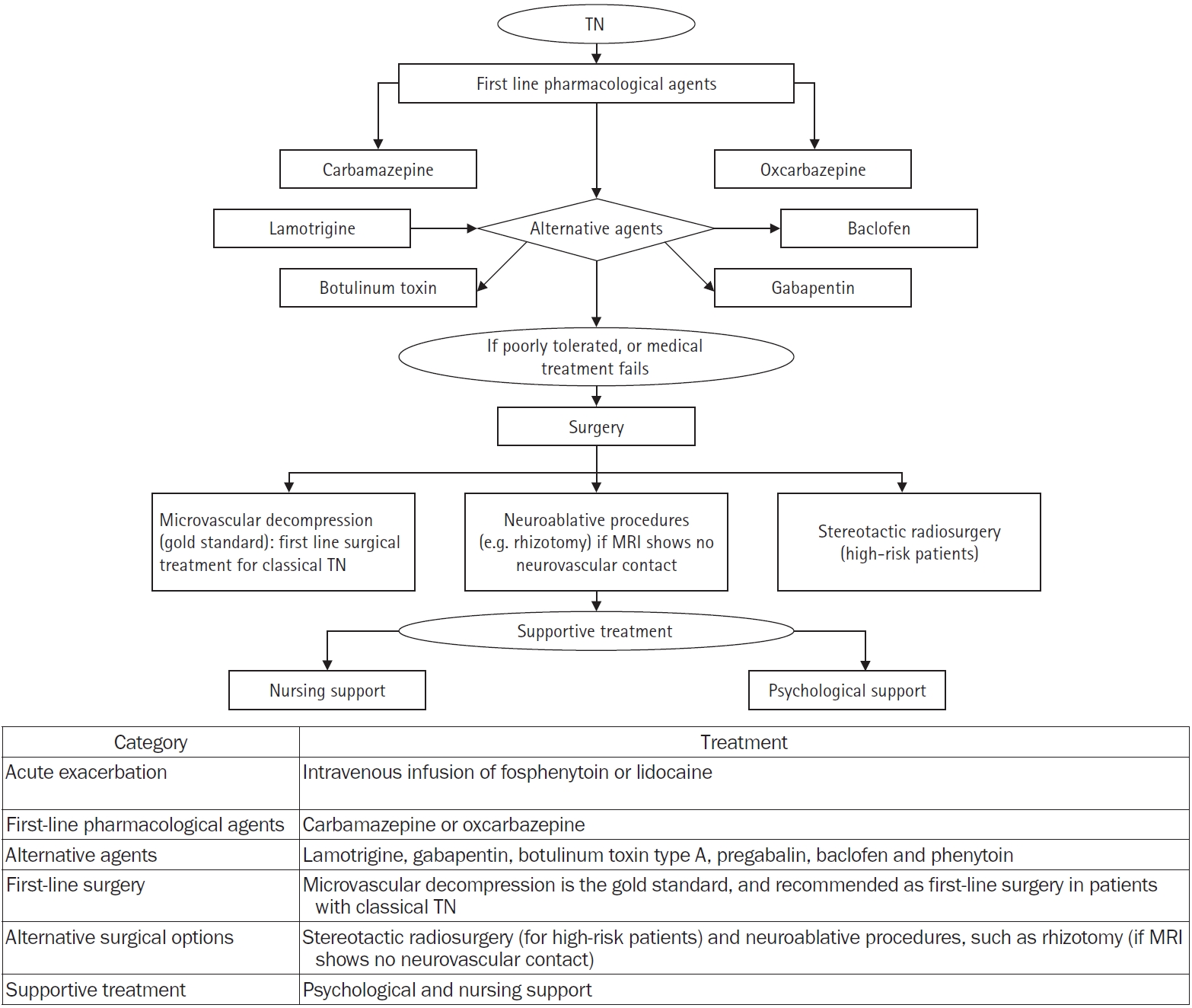
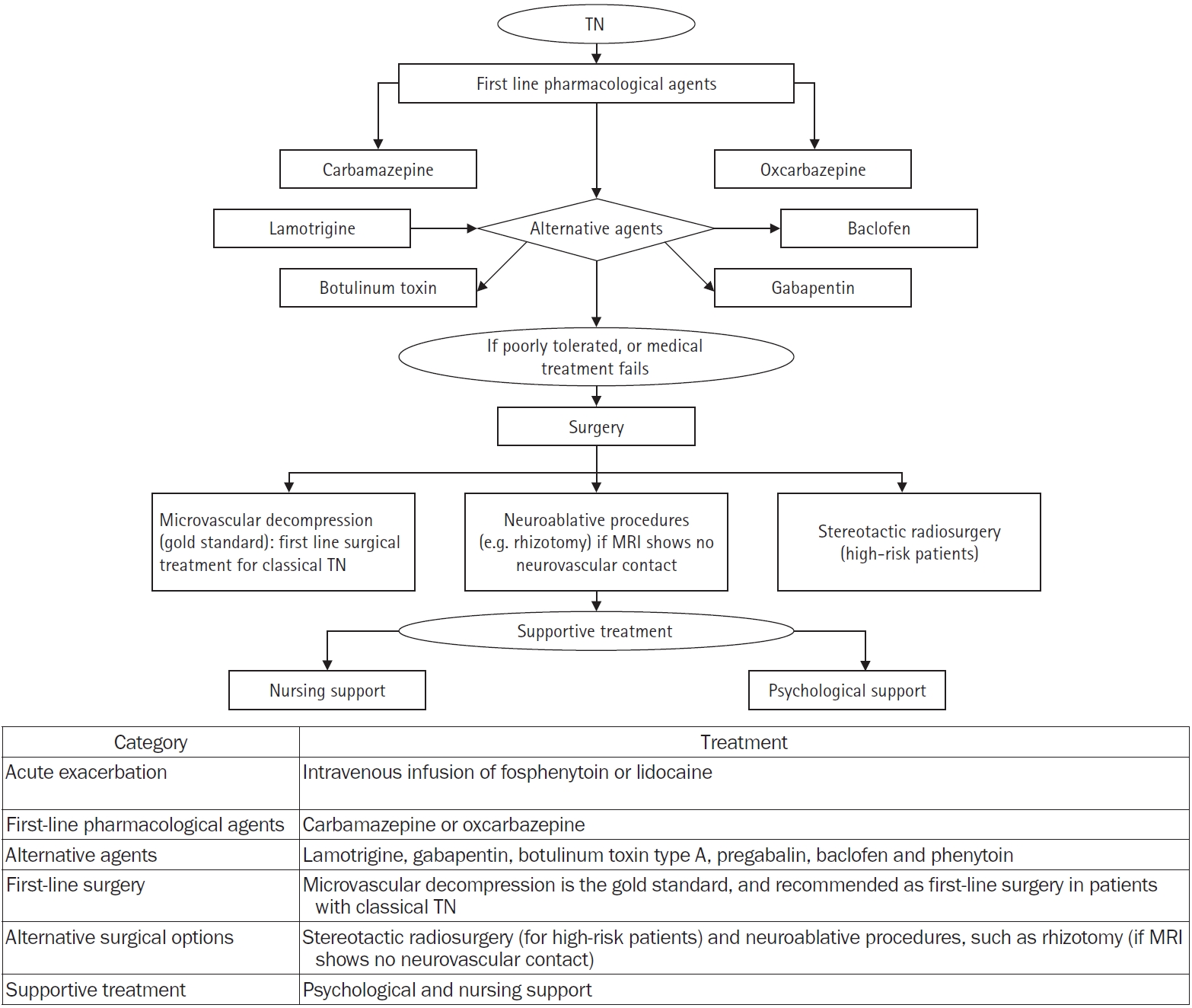
Figure 1.
| Subtypes (4th level diagnosis) | Sub-sub types (5th level diagnosis) |
|---|---|
| Classical trigeminal neuralgia (no apparent cause, except for neurovascular compression) | - Purely paroxysmal |
| - With concomitant continuous pain | |
| Secondary trigeminal neuralgia (caused by an underlying condition; physical examination shows sensory changes in a larger percentage of patients) | - Attributed to multiple sclerosis |
| - Attributed to space-occupying lesion | |
| - Attributed to another cause (e.g., skull-base bone deformity, arteriovenous malformation, connective tissue disorders, dural arteriovenous fistula and genetic causes of neuropathy or peripheral nerve hyperexcitability) | |
| Idiopathic trigeminal neuralgia (no significant abnormalities on magnetic resonance imaging nor electrophysiological tests) | - Purely paroxysmal |
| - With concomitant continuous pain |
| General diagnostic criteria for trigeminal neuralgia | Diagnostic criteria for classical trigeminal neuralgia |
|---|---|
| 1. Recurrent paroxysms of unilateral facial pain in the distribution(s) of one or more trigeminal nerve divisions, with no radiation beyond, and fulfilling criteria 2 and 3 below | Recurrent paroxysms of unilateral facial pain fulfilling criteria for trigeminal neuralgia |
| 2. Pain has all of the following characteristics: | Demonstration on MRI or during surgery of neurovascular compression (not simply contact), with morphological changes in the trigeminal nerve root |
| i. Lasting from a fraction of a second to 2 minutes | |
| ii. Severe intensity | |
| iii. Electric shock-like, shooting, stabbing, or sharp in quality | |
| 3. Precipitated by innocuous stimuli within the affected trigeminal distribution | |
| 4. Not better accounted for by another ICHD-3 diagnosis. |
ICHD-3, International Classification of Headache Disorders, third edition.
ICHD-3, International Classification of Headache Disorders, third edition; MRI, magnetic resonance imaging.
Table 1.
Table 2.
TOP


