 KHS
KHS

Articles
- Page Path
- HOME > Headache Pain Res > Volume 27(2); 2026 > Article
-
Original Article
Guideline for the Treatment of Cluster Headache: A Clinical Practice Guideline from the Korean Headache Society -
Byung-Su Kim1
 , Pil-Wook Chung2, Hong-Kyun Park3, Mi Ji Lee4, Jae Myun Chung5, Kyung Min Kim6, Jiyoung Kim7, Heui-Soo Moon2, Dae-Woong Bae8, Jong-Hee Sohn9, Tae-Jin Song10, Wonwoo Lee11, Soohyun Cho12, Myoung-Jin Cha13, Yun-Ju Choi14, Miyoung Choi15, The Clinical Practice Guideline Committee of the Korean Headache Society
 -
Headache and Pain Research 2026;27(2):124-144.
DOI: https://doi.org/10.62087/hpr.2026.0011
Published online: June 30, 2026
1Department of Neurology, Ewha Womans University Mokdong Hospital, Ewha Womans University College of Medicine, Seoul, Republic of Korea
2Department of Neurology, Kangbuk Samsung Hospital, Sungkyunkwan University School of Medicine, Seoul, Republic of Korea
3Department of Neurology, Inje University Ilsan Paik Hospital, Inje University College of Medicine, Goyang, Republic of Korea
4Department of Neurology, Seoul National University Hospital, Seoul National University College of Medicine, Seoul, Republic of Korea
5Department of Neurology, H Plus Yangji Hospital, Seoul, Republic of Korea
6Department of Neurology, Yonsei University College of Medicine, Seoul, Republic of Korea
7Department of Neurology, Pusan National University Hospital, Busan, Republic of Korea
8Lifelong Neurology Clinic, Dongtan, Republic of Korea
9Department of Neurology, Chuncheon Sacred Heart Hospital, Hallym University College of Medicine, Chuncheon, Republic of Korea
10Department of Neurology, Ewha Womans University Seoul Hospital, Ewha Womans University College of Medicine, Seoul, Republic of Korea
11Department of Neurology, Yongin Severance Hospital, Yonsei University College of Medicine, Yongin, Republic of Korea
12Department of Neurology, Uijeongbu Eulji Medical Center, Eulji University School of Medicine, Uijeongbu, Republic of Korea
13Department of Neurology, National Police Hospital, Seoul, Republic of Korea
14Dr. Choi’s Neurology Clinic, Jeonju, Republic of Korea
15Division Healthcare Research, National Evidence-based Healthcare Collaborating Agency, Seoul, Republic of Korea
- Correspondence: Pil-Wook Chung, M.D., Ph.D. Department of Neurology, Kangbuk Samsung Hospital, Sungkyunkwan University School of Medicine, 29 Saemunan-ro, Jongno-gu, Seoul 03181, Republic of Korea Tel: +82-2-2001-2050, Fax: +82-2-2001-2049, E-mail: chungpw@hanmail.net
© 2026 The Korean Headache Society
This is an Open Access article distributed under the terms of the Creative Commons Attribution Non-Commercial License (https://creativecommons.org/licenses/by-nc/4.0) which permits unrestricted non-commercial use, distribution, and reproduction in any medium, provided the original work is properly cited.
- 4,293 Views
- 81 Download


Abstract
-
Purpose
- This clinical practice guideline (CPG) was developed by the Korean Headache Society (KHS) to provide evidence-based recommendations for the acute and preventive treatment of cluster headache (CH).
-
Methods
- The CPG Committee of the KHS identified key clinical questions regarding the acute and preventive treatment of CH through a systematic literature review. The Grading of Recommendations Assessment, Development and Evaluation (GRADE) methodology was used to assess the quality of evidence and determine the strength of the evidence-based recommendations.
-
Results
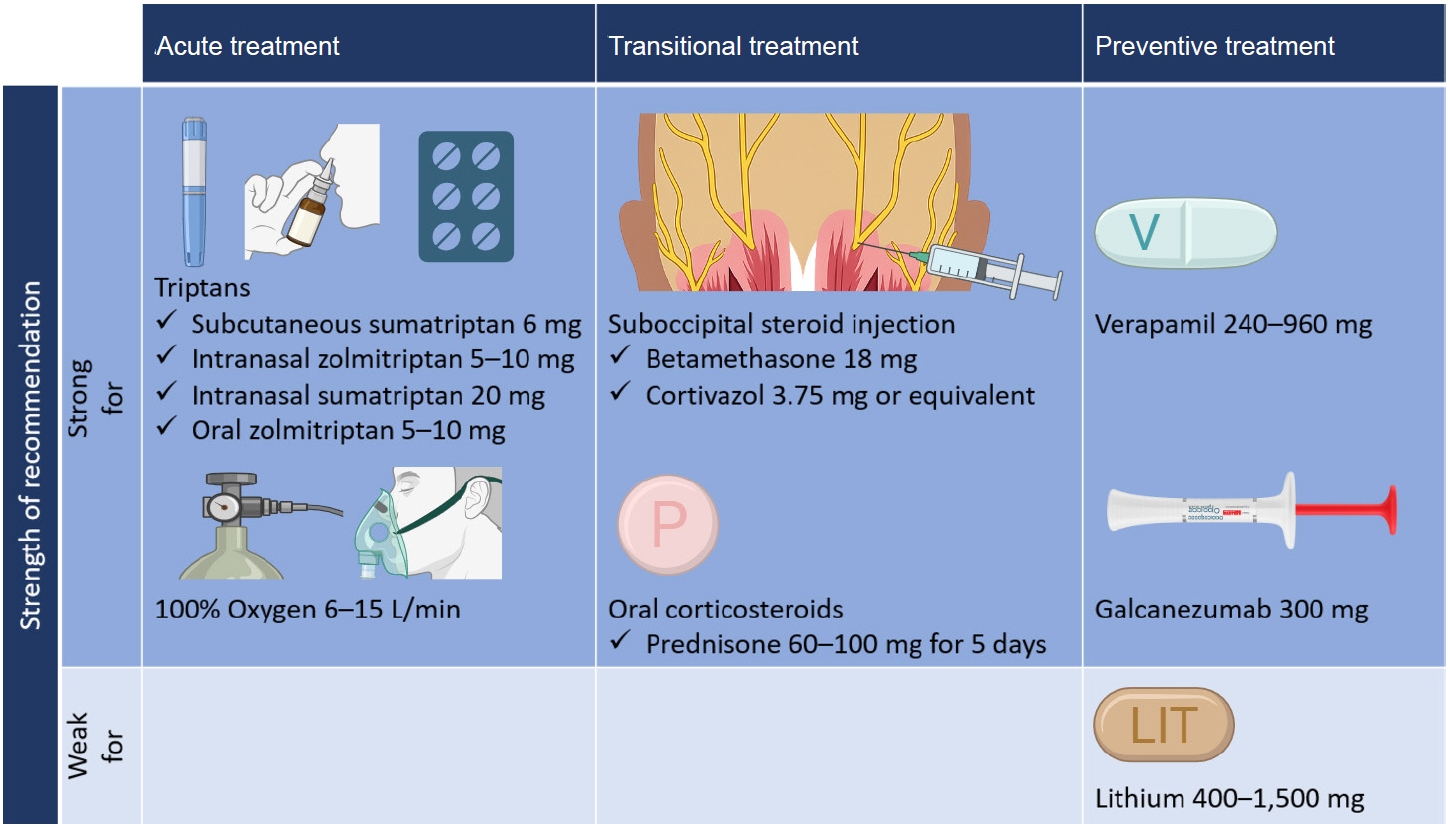
- For acute treatment, subcutaneous sumatriptan, intranasal zolmitriptan, intranasal sumatriptan, oral zolmitriptan, and oxygen are strongly recommended based on moderate-quality evidence. For preventive treatment, suboccipital steroid injection, oral corticosteroids, and galcanezumab (specifically for episodic CH) are strongly recommended based on moderate-quality evidence. Despite the low quality of evidence, verapamil is also strongly recommended, whereas lithium is recommended with a weaker strength of recommendation. Other oral triptans, NSAIDs, ergot derivatives, subcutaneous octreotide, intranasal lidocaine, and non-invasive vagus nerve stimulation (nVNS; specifically for episodic CH) are recommended for acute treatment based on expert consensus. For preventive treatment, topiramate, valproic acid, melatonin, and nVNS (as adjunctive therapy specifically for chronic CH) are recommended, whereas sphenopalatine ganglion stimulation, occipital nerve stimulation, and deep brain stimulation are recommended for patients with refractory chronic CH based on expert consensus.
-
Conclusion
- This CPG provides evidence-based recommendations for the treatment of CH. In addition, the authors recommend the use of expert consensus-based treatments to bridge the gap between the available evidence and real-world clinical practice.
INTRODUCTION
MATERIALS AND METHODS
RESULTS
1) Key question 1
(1) PICO elements
(2) Summary of evidence
① Subcutaneous sumatriptan
② Intranasal zolmitriptan
③ Intranasal sumatriptan
④ Oral zolmitriptan
(3) Recommendation
2) Key question 2
(1) PICO elements
(2) Summary of evidence
(3) Recommendation
3) Key question 3
(1) PICO elements
(2) Summary of evidence
(3) Recommendation
4) Key question 4
(1) PICO elements
(2) Summary of evidence
(3) Recommendation
5) Key question 5
(1) PICO elements
(2) Summary of evidence
(3) Recommendation
6) Key question 6
(1) PICO elements
(2) Summary of evidence
(3) Recommendation
7) Key question 7
(1) PICO elements
(2) Summary of evidence
(3) Recommendation
1) Other acute treatment
(1) Other triptans
① Summary of evidence
② Recommendation
(2) Non-steroidal anti-inflammatory drugs and ergot derivatives
① Summary of evidence
② Recommendation
(3) Octreotide
① Summary of evidence
② Recommendation
(4) Lidocaine
① Summary of evidence
② Recommendation
2) Other preventive treatment
(1) Topiramate
① Summary of evidence
② Recommendation
(2) Valproic acid
① Summary of evidence
② Recommendation
(3) Melatonin
① Summary of evidence
② Recommendation
3) Neuromodulation
(1) Non-invasive vagus nerve stimulation
① Summary of evidence
② Recommendation
(2) Sphenopalatine ganglion stimulation
① Summary of evidence
② Recommendation
(3) Occipital nerve stimulation
① Summary of evidence
② Recommendation
(4) Deep brain stimulation
① Summary of evidence
② Recommendation
AVAILABILITY OF DATA AND MATERIAL
Not applicable.
AUTHOR CONTRIBUTIONS
Conceptualization: BSK, PWC, HKP, MJL, JMC, MC; Data curation: BSK, PWC, HKP, MJL, JMC, MC; Formal analysis: BSK, PWC, HKP, MJL, JMC, MC; Investigation: BSK, PWC, HKP, MJL, JMC, KMK, JK, HSM, DWB, JHS, TJS, WL, SC, MJC, YJC; Methodology: BSK, PWC, HKP, MJL, JMC, MC; Supervision: BSK, PWC, HKP, MJL, JMC, MC; Writing–original draft: BSK, PWC, HKP, MJL, JMC, KMK, JK, HSM, DWB, JHS, TJS, WL, SC, MJC, YJC; Writing–review & editing: BSK, PWC, HKP, MJL, JMC, MC.
CONFLICT OF INTEREST
Mi Ji Lee is the Associate Editor of Headache and Pain Research and was not involved in the review process of this article. All authors have no other conflicts of interest to declare.
FUNDING STATEMENT
None.
ACKNOWLEDGMENTS
None.
SUPPLEMENTARY MATERIAL
Supplementary Figure 1.
Supplementary Figure 2.
| Certainty assessment | No. of patients | Effect | Certainty | ||||||||
|---|---|---|---|---|---|---|---|---|---|---|---|
| No. of studies | Study design | Risk of bias | Inconsistency | Indirectness | Imprecision | Other considerations | Triptan | Placebo | Relative (95% CI) | Absolute (95% CI) | |
| Subcutaneous sumatriptan for pain relief at 15 minutes | |||||||||||
| 2 | Randomized trials | Not serious | Not serious | Not serious | Serious* | None | 98/131 (74.8%) | 41/127 (32.3%) | Not estimable | ⨁⨁⨁◯ | |
| Moderate | |||||||||||
| Subcutaneous sumatriptan for pain-free status at 15 minutes | |||||||||||
| 2 | Randomized trials | Not serious | Not serious | Not serious | Serious† | None | 63/131 (48.1%) | 22/127 (17.3%) | Not estimable | ⨁⨁⨁◯ | |
| Moderate | |||||||||||
| Intranasal zolmitriptan for pain relief at 30 minutes | |||||||||||
| 2 | Randomized trials | Not serious | Not serious | Not serious | Serious* | None | 122/229 (53.3%) | 27/111 (24.3%) | Not estimable | ⨁⨁⨁◯ | |
| Moderate | |||||||||||
| Intranasal zolmitriptan for pain-free status at 30 minutes | |||||||||||
| 2 | Randomized trials | Not serious | Not serious | Not serious | Serious* | None | 92/229 (40.2%) | 20/111 (18.0%) | Not estimable | ⨁⨁⨁◯ | |
| Moderate | |||||||||||
| Intranasal sumatriptan pain response at 30minutes | |||||||||||
| 1 | Randomized trial | Not serious | Not serious | Not serious | Serious‡ | None | Five study centers enrolled 118 patients in whom 154 attacks were treated: 77 with sumatriptan and 77 with placebo. The response rates at 30 minutes were 57% for sumatriptan and 26% for placebo (p=0.002). The pain-free rates at 30 minutes were 47% for sumatriptan and 18% for placebo (p=0.003). | ⨁⨁⨁◯ | |||
| Moderate | |||||||||||
| Oral zolmitriptan for pain relief at 30 minutes | |||||||||||
| 1 | Randomized trial | Not serious | Not serious | Not serious | Serious§ | None | Zolmitrptan 10 mg produced significant pain relief at 30 minutes compared with placebo in patients with episodic headache (46.8% versus 28.9%; p=0.02). Zolmitriptan 5 mg in patients with episodic cluster headache was not significantly different from placebo. | ⨁⨁⨁◯ | |||
| Moderate | |||||||||||
GRADE, Grading of Recommendations Assessment; Development and Evaluation; CI, confidence interval.
*Two randomized controlled trials (RCTs) and small sample size;
†Study design flawed: allocation and random sequence generation;
‡Single RCT and small sample size;
§Single RCT and different effect among doses and headache type (episodic vs. chronic).
| Certainty assessment | Impact | Certainty | Importance | ||||||
|---|---|---|---|---|---|---|---|---|---|
| No. of studies | Study design | Risk of bias | Inconsistency | Indirectness | Imprecision | Other considerations | |||
| Pain-free status at 15 minutes | |||||||||
| 1 | Randomized trial | Not serious | Not serious | Not serious | Serious* | None | Fifty-seven patients with episodic cluster headache and 19 with chronic cluster headache were available for analysis. For the primary end point the difference between oxygen, 78% (95% CI, 71%–85% for 150 attacks) and air, 20% (95% CI, 14%–26%; for 148 attacks) was significant. | ⨁⨁⨁◯ | CRITICAL |
| Moderate | |||||||||
| Pain-free status at 30 minutes | |||||||||
| 1 | Randomized trial | Not serious | Not serious | Not serious | Serious* | None | 72% of oxygen-treated attacks and 24% of placebo-treated attacks were pain-free at 30 minutes. | ⨁⨁⨁◯ | IMPORTANT |
| Moderate | |||||||||
| Certainty assessment | Impact | Certainty | Importance | ||||||
|---|---|---|---|---|---|---|---|---|---|
| No. of studies | Study design | Risk of bias | Inconsistency | Indirectness | Imprecision | Other considerations | |||
| Percentages of patients with two or fewer attacks per day in the 2–4 days after the third injection | |||||||||
| 1 | Randomized trial | Not serious | Not serious | Not serious | Serious* | None | Forty-three patients (15 with chronic and 28 with episodic cluster headache) received cortivazol or placebo. Among the 21 patients who received cortivazol, 20 had a mean of two or fewer daily attacks after injections compared with 12 of 22 controls (odds ratio, 14.5; 95% CI, 1.8–116.9; p=0.012). | ⨁⨁⨁◯ | CRITICAL |
| Moderate | |||||||||
| Total number of attacks between day 1 and day 15 | |||||||||
| 1 | Randomized trial | Not serious | Not serious | Not serious | Serious* | None | Patients who received cortivazol also had fewer attacks (mean, 10.6; 95% CI, 1.4–19.9) in the first 15 days of the study than did controls (mean, 30.3; 95% CI, 21.4–39.3; mean difference, 19.7; 95% CI, 6.8–32.6; p=0.004). | ⨁⨁⨁◯ | IMPORTANT |
| Moderate | |||||||||
| Disappearance of attacks within 72 hours for the 1st week (sustained attack-free 72 hours to 1 week) | |||||||||
| 1 | Randomized trial | Serious† | Not serious | Not serious | Serious* | None | Thirteen patients were allocated to the steroid arm and 10 patients were allocated to the placebo arm. Eleven steroid group patients (85%) became attack-free in the first week after the injection compared to none in the placebo group (p=0.0001). | ⨁⨁◯◯ | CRITICAL |
| Low | |||||||||
| Certainty assessment | Impact | Certainty | Importance | ||||||
|---|---|---|---|---|---|---|---|---|---|
| No. of studies | Study design | Risk of bias | Inconsistency | Indirectness | Imprecision | Other considerations | |||
| Mean number of attacks within the first week of treatment | |||||||||
| 1 | Randomized trial | Not serious | Not serious | Not serious | Serious* | None | The mean number of attacks within the first week of treatment (day 1–7) was 7.1 (SD, 6.5) in the prednisone group compared with 9.5 (SD, 6.0; difference, –2,4; 95% CI, –4.8 to –0.03; p=0.002) in the placebo group. | ⨁⨁⨁◯ | CRITICAL |
| Moderate | |||||||||
| Number of cluster headache attacks after 28 days | |||||||||
| 1 | Randomized trial | Not serious | Not serious | Not serious | Serious* | None | The mean number of cluster headache attacks after 28 days in the prednisone group was still reduced compared with placebo: 15.6 (SD, 15.5) versus 20.2 (SD, 15.0) attacks (difference, –4.7; 95% CI, –11.0 to –1.7, p=0.0356). | ⨁⨁⨁◯ | IMPORTANT |
| Moderate | |||||||||
| 50% reduction in attack frequency at day 7 | |||||||||
| 1 | Randomized trial | Not serious | Not serious | Not serious | Serious* | None | At least a 50% reduction in attack frequency at day 7 was reported by 25 (49%) of 51 patients with prednisone treatment compared with eight (15%) of 55 patients with placebo. | ⨁⨁⨁◯ | IMPORTANT |
| Moderate | |||||||||
| Certainty assessment | Impact | Certainty | Importance | ||||||
|---|---|---|---|---|---|---|---|---|---|
| No. of studies | Study design | Risk of bias | Inconsistency | Indirectness | Imprecision | Other considerations | |||
| Percentage of the patients whose attacks were substantially improved in 1 week | |||||||||
| 1 | Randomized trial | Serious* | Not serious | Not serious | Serious† | None | Thirteen in the lithium group and 14 in the placebo group. | ⨁⨁◯◯ | IMPORTANT |
| Substantial improvement was reached in 62% of the lithium group and 43% of the placebo group. | Low | ||||||||
| Headache index reduction compared to verapamil in preventing chronic cluster headache | |||||||||
| 1 | Randomized trial | Serious* | Not serious | Serious‡ | Serious† | None | In a randomized crossover trial, both lithium and verapamil reduced headache index in chronic cluster headache, but verapamil had fewer adverse effects and a shorter latency of action. | ⨁◯◯◯ | CRITICAL |
| Very low | |||||||||
| Certainty assessment | Impact | Certainty | Importance | ||||||
|---|---|---|---|---|---|---|---|---|---|
| No. of studies | Study design | Risk of bias | Inconsistency | Indirectness | Imprecision | Other considerations | |||
| Reduced headache attack frequency | |||||||||
| 1 | Randomized trial | Serious* | Not serious | Not serious | Serious† | None | In the second week both the number of attacks (verapamil 0.6±0.88, placebo 1.65±1.01; p<0.001) and the consumption of analgesics (verapamil 0.5±0.87, placebo 1.2±1.03; p<0.004) were lower in the verapamil arm than the placebo arm. | ⨁⨁◯◯ | CRITICAL |
| Low | |||||||||
| Headache index reduction compared to lithium in preventing chronic cluster headache | |||||||||
| 1 | Randomized trial | Serious* | Not serious | Serious‡ | Serious† | None | In a randomized double-blind crossover trial, both lithium and verapamil reduced chronic cluster headache attacks, but verapamil was associated with fewer adverse effects and a shorter latency of action. | ⨁◯◯◯ | CRITICAL |
| Very low | |||||||||
| Certainty assessment | Impact | Certainty | Importance | ||||||
|---|---|---|---|---|---|---|---|---|---|
| No. of studies | Study design | Risk of bias | Inconsistency | Indirectness | Imprecision | Other considerations | |||
| Mean change from baseline in the weekly frequency of cluster headache attacks across weeks 1 through 3 | |||||||||
| 1 | Randomized trial | Not serious | Not serious | Not serious | Serious* | None | Of 106 enrolled patients, 49 were randomly assigned to receive galcanezumab and 57 to receive placebo. The mean (±SD) number of cluster headache attacks per week in the baseline period was 17.8±10.1 in the galcanezumab group and 17.3±10.1 in the placebo group. The mean reduction in the weekly frequency of cluster headache attacks across weeks 1 through 3 was 8.7 attacks in the galcanezumab group, as compared with 5.2 in the placebo group (difference, 3.5 attacks per week; 95% CI, 0.2–6.7; p=0.04). | ⨁⨁⨁◯ | CRITICAL |
| Moderate | |||||||||
| Percentage of patients with a reduction from baseline of at least 50% in the weekly frequency of cluster headache attacks at week 3 | |||||||||
| 1 | Randomized trial | Not serious | Not serious | Not serious | Serious† | None | The percentage of patients who had a reduction of at least 50% in headache frequency at week 3 was 71% in the galcanezumab group and 53% in the placebo group. | ⨁⨁⨁◯ | IMPORTANT |
| Moderate | |||||||||
- 1. Kim BK, Cho SJ, Kim BS, et al. Comprehensive application of the International Classification of Headache Disorders third edition, beta version. J Korean Med Sci 2016;31:106-113.ArticlePubMedPMCPDF
- 2. Fischera M, Marziniak M, Gralow I, Evers S. The incidence and prevalence of cluster headache: a meta-analysis of population-based studies. Cephalalgia 2008;28:614-618.ArticlePubMedPDF
- 3. Ji Lee M, Cho SJ, Park JW, et al. Increased suicidality in patients with cluster headache. Cephalalgia 2019;39:1249-1256.ArticlePubMedPDF
- 4. Goadsby PJ, Dodick DW, Leone M, et al. Trial of galcanezumab in prevention of episodic cluster headache. N Engl J Med 2019;381:132-141.ArticlePubMedPMC
- 5. Guyatt GH, Oxman AD, Vist GE, et al. GRADE: an emerging consensus on rating quality of evidence and strength of recommendations. BMJ 2008;336:924-926.ArticlePubMedPMC
- 6. Schardt C, Adams MB, Owens T, Keitz S, Fontelo P. Utilization of the PICO framework to improve searching PubMed for clinical questions. BMC Med Inform Decis Mak 2007;7:16.ArticlePubMedPMCPDF
- 7. Sterne JAC, Savović J, Page MJ, et al. RoB 2: a revised tool for assessing risk of bias in randomised trials. BMJ 2019;366:l4898.Article
- 8. Guyatt GH, Oxman AD, Kunz R, et al. Going from evidence to recommendations. BMJ 2008;336:1049-1051.ArticlePubMedPMC
- 9. Sumatriptan Cluster Headache Study Group. Treatment of acute cluster headache with sumatriptan. N Engl J Med 1991;325:322-326.ArticlePubMed
- 10. Ekbom K, Monstad I, Prusinski A, Cole JA, Pilgrim AJ, Noronha D. Subcutaneous sumatriptan in the acute treatment of cluster headache: a dose comparison study. The Sumatriptan Cluster Headache Study Group. Acta Neurol Scand 1993;88:63-69.ArticlePubMed
- 11. Cittadini E, May A, Straube A, Evers S, Bussone G, Goadsby PJ. Effectiveness of intranasal zolmitriptan in acute cluster headache: a randomized, placebo-controlled, double-blind crossover study. Arch Neurol 2006;63:1537-1542.ArticlePubMed
- 12. Rapoport AM, Mathew NT, Silberstein SD, et al. Zolmitriptan nasal spray in the acute treatment of cluster headache: a double-blind study. Neurology 2007;69:821-826.ArticlePubMed
- 13. van Vliet JA, Bahra A, Martin V, et al. Intranasal sumatriptan in cluster headache: randomized placebo-controlled double-blind study. Neurology 2003;60:630-633.Article
- 14. Bahra A, Gawel MJ, Hardebo JE, Millson D, Breen SA, Goadsby PJ. Oral zolmitriptan is effective in the acute treatment of cluster headache. Neurology 2000;54:1832-1839.ArticlePubMed
- 15. Law S, Derry S, Moore RA. Triptans for acute cluster headache. Cochrane Database Syst Rev 2013;2013:CD008042.ArticlePubMedPMC
- 16. Fogan L. Treatment of cluster headache. A double-blind comparison of oxygen v air inhalation. Arch Neurol 1985;42:362-363.ArticlePubMed
- 17. Cohen AS, Burns B, Goadsby PJ. High-flow oxygen for treatment of cluster headache: a randomized trial. JAMA 2009;302:2451-2457.ArticlePubMed
- 18. Ambrosini A, Vandenheede M, Rossi P, et al. Suboccipital injection with a mixture of rapid- and long-acting steroids in cluster headache: a double-blind placebo-controlled study. Pain 2005;118:92-96.ArticlePubMed
- 19. Leroux E, Valade D, Taifas I, et al. Suboccipital steroid injections for transitional treatment of patients with more than two cluster headache attacks per day: a randomised, double-blind, placebo-controlled trial. Lancet Neurol 2011;10:891-897.ArticlePubMed
- 20. Obermann M, Nägel S, Ose C, et al. Safety and efficacy of prednisone versus placebo in short-term prevention of episodic cluster headache: a multicentre, double-blind, randomised controlled trial. Lancet Neurol 2021;20:29-37.ArticlePubMedPMC
- 21. Bussone G, Leone M, Peccarisi C, et al. Double blind comparison of lithium and verapamil in cluster headache prophylaxis. Headache 1990;30:411-417.ArticlePubMed
- 22. Steiner TJ, Hering R, Couturier EG, Davies PT, Whitmarsh TE. Double-blind placebo-controlled trial of lithium in episodic cluster headache. Cephalalgia 1997;17:673-675.ArticlePubMedPDF
- 23. Leone M, D’Amico D, Frediani F, et al. Verapamil in the prophylaxis of episodic cluster headache: a double-blind study versus placebo. Neurology 2000;54:1382-1385.ArticlePubMed
- 24. Dodick DW, Goadsby PJ, Lucas C, et al. Phase 3 randomized, placebo-controlled study of galcanezumab in patients with chronic cluster headache: results from 3-month double-blind treatment. Cephalalgia 2020;40:935-948.ArticlePubMedPMCPDF
- 25. Mo H, Kim BK, Moon HS, Cho SJ. Real-world experience with 240 mg of galcanezumab for the preventive treatment of cluster headache. J Headache Pain 2022;23:132.ArticlePubMedPMCPDF
- 26. Lee MJ, Park JW, Chu MK, et al. Treatment pattern and response for cluster headache in Korea: a prospective multicenter observation study. Cephalalgia 2023;43:3331024231159627.ArticlePubMedPDF
- 27. Pearson SM, Burish MJ, Shapiro RE, Yan Y, Schor LI. Effectiveness of oxygen and other acute treatments for cluster headache: results from the Cluster Headache Questionnaire, an international survey. Headache 2019;59:235-249.ArticlePubMedPMCPDF
- 28. Andersson PG, Jespersen LT. Dihydroergotamine nasal spray in the treatment of attacks of cluster headache. A double-blind trial versus placebo. Cephalalgia 1986;6:51-54.ArticlePubMedPDF
- 29. Matharu MS, Levy MJ, Meeran K, Goadsby PJ. Subcutaneous octreotide in cluster headache: randomized placebo-controlled double-blind crossover study. Ann Neurol 2004;56:488-494.ArticlePubMed
- 30. Costa A, Pucci E, Antonaci F, et al. The effect of intranasal cocaine and lidocaine on nitroglycerin-induced attacks in cluster headache. Cephalalgia 2000;20:85-91.ArticlePubMedPDF
- 31. Barzegari H, Motamed H, Ziapour B, Hajimohammadi M, Kadkhodazadeh M. Intranasal lidocaine for primary headache management in emergency department; a clinical trial. Emerg (Tehran) 2017;5:e79.
- 32. Robbins L. Intranasal lidocaine for cluster headache. Headache 1995;35:83-84.ArticlePubMed
- 33. Dagenais R, Zed PJ. Intranasal lidocaine for acute management of primary headaches: a systematic review. Pharmacotherapy 2018;38:1038-1050.ArticlePubMedPDF
- 34. Huang WY, Lo MC, Wang SJ, Tsai JJ, Wu HM. Topiramate in prevention of cluster headache in the Taiwanese. Neurol India 2010;58:284-287.ArticlePubMed
- 35. Leone M, Dodick D, Rigamonti A, et al. Topiramate in cluster headache prophylaxis: an open trial. Cephalalgia 2003;23:1001-1002.ArticlePubMedPDF
- 36. Hering R, Kuritzky A. Sodium valproate in the treatment of cluster headache: an open clinical trial. Cephalalgia 1989;9:195-198.ArticlePubMed
- 37. El Amrani M, Massiou H, Bousser MG. A negative trial of sodium valproate in cluster headache: methodological issues. Cephalalgia 2002;22:205-208.ArticlePubMedPDF
- 38. Leone M, D’Amico D, Moschiano F, Fraschini F, Bussone G. Melatonin versus placebo in the prophylaxis of cluster headache: a double-blind pilot study with parallel groups. Cephalalgia 1996;16:494-496.ArticlePubMedPDF
- 39. Pringsheim T, Magnoux E, Dobson CF, Hamel E, Aubé M. Melatonin as adjunctive therapy in the prophylaxis of cluster headache: a pilot study. Headache 2002;42:787-792.ArticlePubMed
- 40. Silberstein SD, Mechtler LL, Kudrow DB, et al. Non-invasive vagus nerve stimulation for the acute treatment of cluster headache: findings from the randomized, double-blind, sham-controlled ACT1 study. Headache 2016;56:1317-1332.ArticlePubMedPMCPDF
- 41. Goadsby PJ, de Coo IF, Silver N, et al. Non-invasive vagus nerve stimulation for the acute treatment of episodic and chronic cluster headache: a randomized, double-blind, sham-controlled ACT2 study. Cephalalgia 2018;38:959-969.ArticlePubMedPMCPDF
- 42. de Coo IF, Marin JC, Silberstein SD, et al. Differential efficacy of non-invasive vagus nerve stimulation for the acute treatment of episodic and chronic cluster headache: a meta-analysis. Cephalalgia 2019;39:967-977.ArticlePubMedPMCPDF
- 43. Gaul C, Diener HC, Silver N, et al. Non-invasive vagus nerve stimulation for PREVention and Acute treatment of chronic cluster headache (PREVA): a randomised controlled study. Cephalalgia 2016;36:534-546.ArticlePubMedPMCPDF
- 44. Schoenen J, Jensen RH, Lantéri-Minet M, et al. Stimulation of the sphenopalatine ganglion (SPG) for cluster headache treatment. Pathway CH-1: a randomized, sham-controlled study. Cephalalgia 2013;33:816-830.ArticlePubMedPMCPDF
- 45. Jürgens TP, Barloese M, May A, et al. Long-term effectiveness of sphenopalatine ganglion stimulation for cluster headache. Cephalalgia 2017;37:423-434.ArticlePubMedPMCPDF
- 46. Barloese M, Petersen A, Stude P, Jürgens T, Jensen RH, May A. Sphenopalatine ganglion stimulation for cluster headache, results from a large, open-label European registry. J Headache Pain 2018;19:6.ArticlePubMedPMCPDF
- 47. Goadsby PJ, Sahai-Srivastava S, Kezirian EJ, et al. Safety and efficacy of sphenopalatine ganglion stimulation for chronic cluster headache: a double-blind, randomised controlled trial. Lancet Neurol 2019;18:1081-1090.ArticlePubMed
- 48. Fontaine D, Santucci S, Lanteri-Minet M. Managing cluster headache with sphenopalatine ganglion stimulation: a review. J Pain Res 2018;11:375-381.ArticlePubMedPMCPDF
- 49. Leone M, Proietti Cecchini A, Messina G, Franzini A. Long-term occipital nerve stimulation for drug-resistant chronic cluster headache. Cephalalgia 2017;37:756-763.ArticlePubMedPDF
- 50. Miller S, Watkins L, Matharu M. Treatment of intractable chronic cluster headache by occipital nerve stimulation: a cohort of 51 patients. Eur J Neurol 2017;24:381-390.ArticlePubMedPMCPDF
- 51. Wilbrink LA, de Coo IF, Doesborg PGG, et al. Safety and efficacy of occipital nerve stimulation for attack prevention in medically intractable chronic cluster headache (ICON): a randomised, double-blind, multicentre, phase 3, electrical dose-controlled trial. Lancet Neurol 2021;20:515-525.ArticlePubMed
- 52. Fontaine D, Lazorthes Y, Mertens P, et al. Safety and efficacy of deep brain stimulation in refractory cluster headache: a randomized placebo-controlled double-blind trial followed by a 1-year open extension. J Headache Pain 2010;11:23-31.ArticlePubMedPMCPDF
- 53. Nowacki A, Schober M, Nader L, et al. Deep brain stimulation for chronic cluster headache: meta-analysis of individual patient data. Ann Neurol 2020;88:956-969.ArticlePubMedPDF
- 54. Murray M, Pahapill PA, Awad AJ. Deep brain stimulation for chronic cluster headaches: a systematic review and meta-analysis. Stereotact Funct Neurosurg 2023;101:232-243.ArticlePubMedPDF
REFERENCES
Figure & Data
References
Citations

 PubReader
 ePub Link
-
 Cite this Article
- Cite this Article
-
- Close
- Download Citation
- Close
 XML Download
- Figure
-

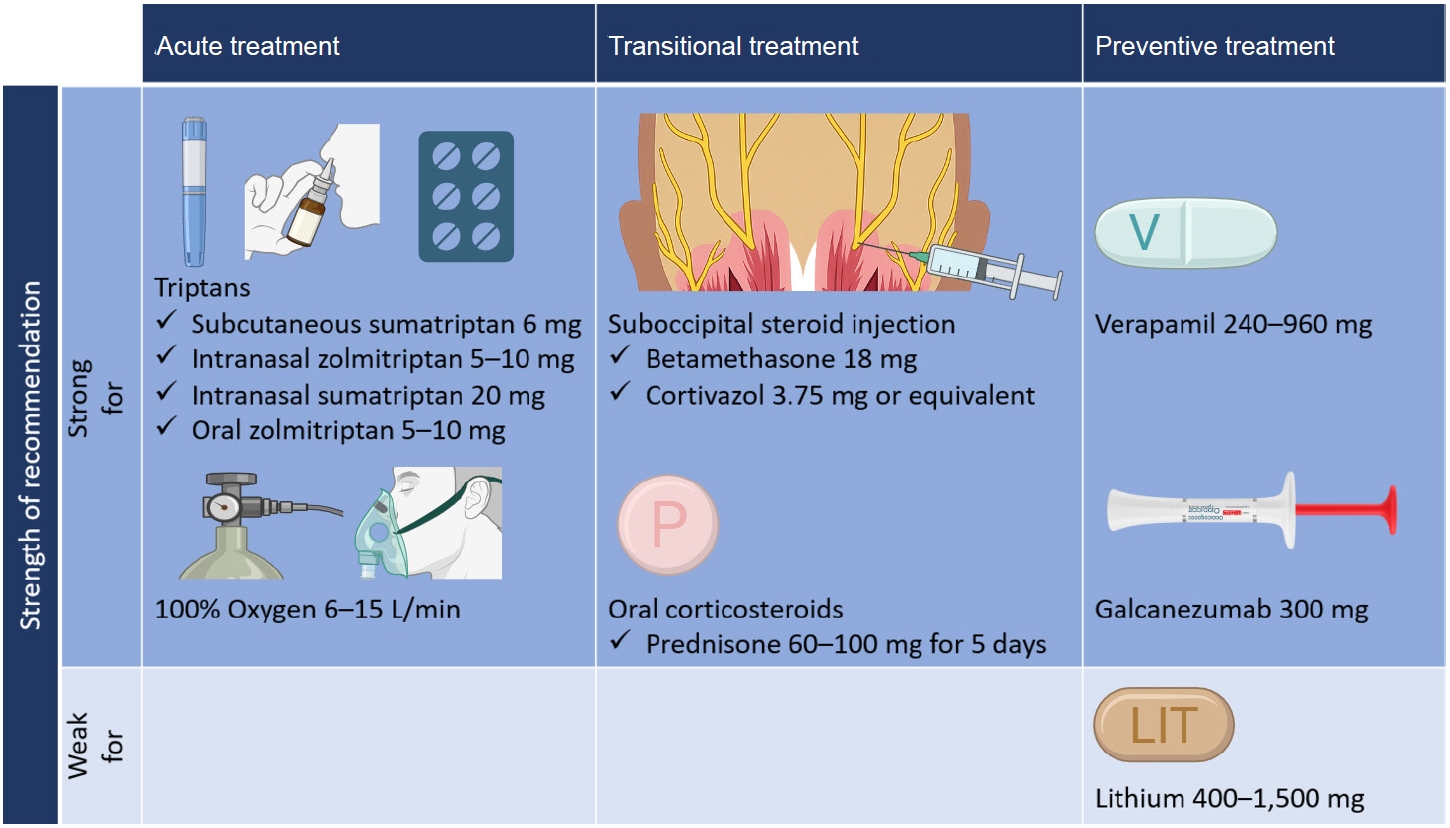
Figure 1.
| Certainty assessment | No. of patients | Effect | Certainty | ||||||||
|---|---|---|---|---|---|---|---|---|---|---|---|
| No. of studies | Study design | Risk of bias | Inconsistency | Indirectness | Imprecision | Other considerations | Triptan | Placebo | Relative (95% CI) | Absolute (95% CI) | |
| Subcutaneous sumatriptan for pain relief at 15 minutes | |||||||||||
| 2 | Randomized trials | Not serious | Not serious | Not serious | Serious |
None | 98/131 (74.8%) | 41/127 (32.3%) | Not estimable | ⨁⨁⨁◯ | |
| Moderate | |||||||||||
| Subcutaneous sumatriptan for pain-free status at 15 minutes | |||||||||||
| 2 | Randomized trials | Not serious | Not serious | Not serious | Serious |
None | 63/131 (48.1%) | 22/127 (17.3%) | Not estimable | ⨁⨁⨁◯ | |
| Moderate | |||||||||||
| Intranasal zolmitriptan for pain relief at 30 minutes | |||||||||||
| 2 | Randomized trials | Not serious | Not serious | Not serious | Serious |
None | 122/229 (53.3%) | 27/111 (24.3%) | Not estimable | ⨁⨁⨁◯ | |
| Moderate | |||||||||||
| Intranasal zolmitriptan for pain-free status at 30 minutes | |||||||||||
| 2 | Randomized trials | Not serious | Not serious | Not serious | Serious |
None | 92/229 (40.2%) | 20/111 (18.0%) | Not estimable | ⨁⨁⨁◯ | |
| Moderate | |||||||||||
| Intranasal sumatriptan pain response at 30minutes | |||||||||||
| 1 | Randomized trial | Not serious | Not serious | Not serious | Serious |
None | Five study centers enrolled 118 patients in whom 154 attacks were treated: 77 with sumatriptan and 77 with placebo. The response rates at 30 minutes were 57% for sumatriptan and 26% for placebo (p=0.002). The pain-free rates at 30 minutes were 47% for sumatriptan and 18% for placebo (p=0.003). | ⨁⨁⨁◯ | |||
| Moderate | |||||||||||
| Oral zolmitriptan for pain relief at 30 minutes | |||||||||||
| 1 | Randomized trial | Not serious | Not serious | Not serious | Serious |
None | Zolmitrptan 10 mg produced significant pain relief at 30 minutes compared with placebo in patients with episodic headache (46.8% versus 28.9%; p=0.02). Zolmitriptan 5 mg in patients with episodic cluster headache was not significantly different from placebo. | ⨁⨁⨁◯ | |||
| Moderate | |||||||||||
| Certainty assessment | Impact | Certainty | Importance | ||||||
|---|---|---|---|---|---|---|---|---|---|
| No. of studies | Study design | Risk of bias | Inconsistency | Indirectness | Imprecision | Other considerations | |||
| Pain-free status at 15 minutes | |||||||||
| 1 | Randomized trial | Not serious | Not serious | Not serious | Serious |
None | Fifty-seven patients with episodic cluster headache and 19 with chronic cluster headache were available for analysis. For the primary end point the difference between oxygen, 78% (95% CI, 71%–85% for 150 attacks) and air, 20% (95% CI, 14%–26%; for 148 attacks) was significant. | ⨁⨁⨁◯ | CRITICAL |
| Moderate | |||||||||
| Pain-free status at 30 minutes | |||||||||
| 1 | Randomized trial | Not serious | Not serious | Not serious | Serious |
None | 72% of oxygen-treated attacks and 24% of placebo-treated attacks were pain-free at 30 minutes. | ⨁⨁⨁◯ | IMPORTANT |
| Moderate | |||||||||
| Certainty assessment | Impact | Certainty | Importance | ||||||
|---|---|---|---|---|---|---|---|---|---|
| No. of studies | Study design | Risk of bias | Inconsistency | Indirectness | Imprecision | Other considerations | |||
| Percentages of patients with two or fewer attacks per day in the 2–4 days after the third injection | |||||||||
| 1 | Randomized trial | Not serious | Not serious | Not serious | Serious |
None | Forty-three patients (15 with chronic and 28 with episodic cluster headache) received cortivazol or placebo. Among the 21 patients who received cortivazol, 20 had a mean of two or fewer daily attacks after injections compared with 12 of 22 controls (odds ratio, 14.5; 95% CI, 1.8–116.9; p=0.012). | ⨁⨁⨁◯ | CRITICAL |
| Moderate | |||||||||
| Total number of attacks between day 1 and day 15 | |||||||||
| 1 | Randomized trial | Not serious | Not serious | Not serious | Serious |
None | Patients who received cortivazol also had fewer attacks (mean, 10.6; 95% CI, 1.4–19.9) in the first 15 days of the study than did controls (mean, 30.3; 95% CI, 21.4–39.3; mean difference, 19.7; 95% CI, 6.8–32.6; p=0.004). | ⨁⨁⨁◯ | IMPORTANT |
| Moderate | |||||||||
| Disappearance of attacks within 72 hours for the 1st week (sustained attack-free 72 hours to 1 week) | |||||||||
| 1 | Randomized trial | Serious |
Not serious | Not serious | Serious |
None | Thirteen patients were allocated to the steroid arm and 10 patients were allocated to the placebo arm. Eleven steroid group patients (85%) became attack-free in the first week after the injection compared to none in the placebo group (p=0.0001). | ⨁⨁◯◯ | CRITICAL |
| Low | |||||||||
| Certainty assessment | Impact | Certainty | Importance | ||||||
|---|---|---|---|---|---|---|---|---|---|
| No. of studies | Study design | Risk of bias | Inconsistency | Indirectness | Imprecision | Other considerations | |||
| Mean number of attacks within the first week of treatment | |||||||||
| 1 | Randomized trial | Not serious | Not serious | Not serious | Serious |
None | The mean number of attacks within the first week of treatment (day 1–7) was 7.1 (SD, 6.5) in the prednisone group compared with 9.5 (SD, 6.0; difference, –2,4; 95% CI, –4.8 to –0.03; p=0.002) in the placebo group. | ⨁⨁⨁◯ | CRITICAL |
| Moderate | |||||||||
| Number of cluster headache attacks after 28 days | |||||||||
| 1 | Randomized trial | Not serious | Not serious | Not serious | Serious |
None | The mean number of cluster headache attacks after 28 days in the prednisone group was still reduced compared with placebo: 15.6 (SD, 15.5) versus 20.2 (SD, 15.0) attacks (difference, –4.7; 95% CI, –11.0 to –1.7, p=0.0356). | ⨁⨁⨁◯ | IMPORTANT |
| Moderate | |||||||||
| 50% reduction in attack frequency at day 7 | |||||||||
| 1 | Randomized trial | Not serious | Not serious | Not serious | Serious |
None | At least a 50% reduction in attack frequency at day 7 was reported by 25 (49%) of 51 patients with prednisone treatment compared with eight (15%) of 55 patients with placebo. | ⨁⨁⨁◯ | IMPORTANT |
| Moderate | |||||||||
| Certainty assessment | Impact | Certainty | Importance | ||||||
|---|---|---|---|---|---|---|---|---|---|
| No. of studies | Study design | Risk of bias | Inconsistency | Indirectness | Imprecision | Other considerations | |||
| Percentage of the patients whose attacks were substantially improved in 1 week | |||||||||
| 1 | Randomized trial | Serious |
Not serious | Not serious | Serious |
None | Thirteen in the lithium group and 14 in the placebo group. | ⨁⨁◯◯ | IMPORTANT |
| Substantial improvement was reached in 62% of the lithium group and 43% of the placebo group. | Low | ||||||||
| Headache index reduction compared to verapamil in preventing chronic cluster headache | |||||||||
| 1 | Randomized trial | Serious |
Not serious | Serious |
Serious |
None | In a randomized crossover trial, both lithium and verapamil reduced headache index in chronic cluster headache, but verapamil had fewer adverse effects and a shorter latency of action. | ⨁◯◯◯ | CRITICAL |
| Very low | |||||||||
| Certainty assessment | Impact | Certainty | Importance | ||||||
|---|---|---|---|---|---|---|---|---|---|
| No. of studies | Study design | Risk of bias | Inconsistency | Indirectness | Imprecision | Other considerations | |||
| Reduced headache attack frequency | |||||||||
| 1 | Randomized trial | Serious |
Not serious | Not serious | Serious |
None | In the second week both the number of attacks (verapamil 0.6±0.88, placebo 1.65±1.01; p<0.001) and the consumption of analgesics (verapamil 0.5±0.87, placebo 1.2±1.03; p<0.004) were lower in the verapamil arm than the placebo arm. | ⨁⨁◯◯ | CRITICAL |
| Low | |||||||||
| Headache index reduction compared to lithium in preventing chronic cluster headache | |||||||||
| 1 | Randomized trial | Serious |
Not serious | Serious |
Serious |
None | In a randomized double-blind crossover trial, both lithium and verapamil reduced chronic cluster headache attacks, but verapamil was associated with fewer adverse effects and a shorter latency of action. | ⨁◯◯◯ | CRITICAL |
| Very low | |||||||||
| Certainty assessment | Impact | Certainty | Importance | ||||||
|---|---|---|---|---|---|---|---|---|---|
| No. of studies | Study design | Risk of bias | Inconsistency | Indirectness | Imprecision | Other considerations | |||
| Mean change from baseline in the weekly frequency of cluster headache attacks across weeks 1 through 3 | |||||||||
| 1 | Randomized trial | Not serious | Not serious | Not serious | Serious |
None | Of 106 enrolled patients, 49 were randomly assigned to receive galcanezumab and 57 to receive placebo. The mean (±SD) number of cluster headache attacks per week in the baseline period was 17.8±10.1 in the galcanezumab group and 17.3±10.1 in the placebo group. The mean reduction in the weekly frequency of cluster headache attacks across weeks 1 through 3 was 8.7 attacks in the galcanezumab group, as compared with 5.2 in the placebo group (difference, 3.5 attacks per week; 95% CI, 0.2–6.7; p=0.04). | ⨁⨁⨁◯ | CRITICAL |
| Moderate | |||||||||
| Percentage of patients with a reduction from baseline of at least 50% in the weekly frequency of cluster headache attacks at week 3 | |||||||||
| 1 | Randomized trial | Not serious | Not serious | Not serious | Serious |
None | The percentage of patients who had a reduction of at least 50% in headache frequency at week 3 was 71% in the galcanezumab group and 53% in the placebo group. | ⨁⨁⨁◯ | IMPORTANT |
| Moderate | |||||||||
GRADE, Grading of Recommendations Assessment; Development and Evaluation; CI, confidence interval. Two randomized controlled trials (RCTs) and small sample size; Study design flawed: allocation and random sequence generation; Single RCT and small sample size; Single RCT and different effect among doses and headache type (episodic vs. chronic).
GRADE, Grading of Recommendations Assessment; CI, confidence interval. Single study.
GRADE, Grading of Recommendations Assessment; CI, confidence interval. Single randomized controlled trial and small sample size; Small sample size.
GRADE, Grading of Recommendations Assessment; SD, standard deviation; CI, confidence interval. Small sample size and single randomized controlled trial.
GRADE, Grading of Recommendations Assessment. Small sample size Headache index reduction compared to verapamil in preventing chronic cluster headache; Not a placebo-controlled trial (comparison with verapamil).
GRADE, Grading of Recommendations Assessment. Small sample size and flawed design; Singe study and small sample size; Not a placebo-controlled trial.
GRADE, Grading of Recommendations Assessment; SD, standard deviation; CI, confidence interval. Single randomized controlled trial (RCT); Single RCT and small sample size.
Table 1.
Table 2.
Table 3.
Table 4.
Table 5.
Table 6.
Table 7.
TOP


